Snapchat is no longer just a place where friends send quick photos that disappear. It has become a serious marketing channel for brands that want to reach people through short videos, messages, augmented reality, creators, local discovery, and direct-response ads.
The platform works best for businesses that can show personality. A polished commercial can work, but an honest behind-the-scenes video may work better. Snapchat users are used to quick, visual communication. They expect brands to get to the point, look natural, and give them a reason to care.
Snap’s audience is also far larger than many marketers assume. In the first quarter of 2026, Snapchat reported 483 million daily active users and 956 million monthly active users worldwide. Snap Map reached more than 450 million monthly active users, while 75% of Snapchatters used AR every day on average. Snap’s Q1 2026 results show why the platform deserves more attention from marketers.
If your customers include Gen Z, younger millennials, shoppers near a physical location, or people who enjoy visual content, Snapchat can be a useful part of your marketing mix.
Direct Answer
Snapchat for Business helps brands reach customers through Business Profiles, public Stories, Spotlight videos, AR Lenses, Snap Map, creators, and paid ads. It works especially well for visual products, local businesses, ecommerce stores, apps, entertainment brands, and youth-focused services. Start with useful organic content, then use Ads Manager to test targeted campaigns, measure sales, leads, website visits, or app installs.
- What Is Snapchat for Business?
- Why Businesses Should Use Snapchat in 2026
- Setting Up a Snapchat Business Account
- Snapchat Business Manager Explained
- How Snapchat Ads Manager Works
- Snapchat Ad Formats Worth Testing
- Building a Snapchat Marketing Strategy
- The Best Businesses for Snapchat Marketing
- Snapchat Content Ideas for Businesses
- Using Snapchat AR, Creators, and Snap Map
- Snapchat Analytics: What to Measure
- Common Snapchat Marketing Mistakes
- Snapchat vs. Instagram, TikTok, and YouTube Shorts
- Real Snapchat Marketing Examples to Learn From
- Final Thoughts
- FAQ
What Is Snapchat for Business?
Snapchat for Business is the set of tools that brands use to build an audience, publish content, advertise, and measure results on Snapchat. It includes Business Profiles, Ads Manager, Business Manager, Snap Pixel, catalogs, audience tools, reporting, and creative formats such as video ads, collection ads, filters, and AR Lenses.
The main difference between Snapchat and many other social platforms is context. Snapchat began as a private place for close friends. That feeling still exists.
People open the app to talk, react, share a moment, check the map, or watch something short. Brands that respect this behavior tend to perform better than brands that simply recycle a television ad or an Instagram post.
A Snapchat business account can give a company a home inside the app. It can display a logo, description, website, location, public Stories, saved content, Lenses, and other brand assets.
Snapchat says Business Profiles are created and managed through Ads Manager, rather than being automatically created for a business. Its support guidance also notes that Business Profiles can include public Stories, Lenses, saved Stories, and Shopify-powered native commerce stores.
You do not need a huge media budget to start.
A small business can use Snapchat to show daily specials, new stock, customer reactions, staff members, events, or quick product demonstrations. The important part is having a clear reason to be there.
Why Businesses Should Use Snapchat in 2026

Snapchat is useful because it combines discovery, conversation, entertainment, and action into a single app. A person might see a Lens, watch a creator, look at nearby places on Snap Map, tap through a Story, and then visit a website or store. That gives brands several ways to meet people before asking for a purchase.
The platform is particularly strong for reaching younger audiences. That does not mean every Snapchat user is a teenager, nor does it mean older customers are absent. It means brands should understand that the culture is fast, visual, playful, and mobile-first.
If your marketing team needs every post to look formal and permanent, Snapchat may feel uncomfortable at first. That is often a sign that the team needs a different creative approach, not that the platform is wrong.

Augmented reality is another reason to pay attention. A customer can try on sunglasses, test makeup shades, place furniture in a room, play with a branded effect, or interact with a product in a way that a normal video cannot match.
Snap reported that its community used AR Lenses more than nine billion times per day on average in Q1 2026. That same company report shows how central the camera remains to the user experience.
For local businesses, Snap Map and location-based ads can also be valuable. A restaurant, gym, retail shop, attraction, college, salon, or event venue can use Snapchat to create awareness near the point where customers can actually visit.
Setting Up a Snapchat Business Account

Start by deciding what your Snapchat presence needs to do. Do you want people to discover your brand? Visit a store? Buy online? Download an app? Join a waitlist?
The answer will shape your profile, content, link strategy, and advertising setup.
Create a Business Profile through Snapchat Ads Manager. Use your real business name and choose a username that is easy to recognize.
Add a profile photo that still looks clear on a small screen. Write a short description that explains what you sell and why someone should follow you. Add your website, contact details, category, and location where available.

Your profile should not be empty after launch. Prepare a small group of saved Stories before promoting them.
A clothing shop might save a “New Arrivals” Story, a “Sizing Help” Story, a “Customer Favorites” Story, and a “Visit Us” Story. A service business might save “How It Works,” “Before and After,” “Prices,” and “Meet the Team.” These give new visitors a quick picture of the business.
Keep the account separate from a founder’s personal account unless the founder is the brand. Staff access, payment details, advertising assets, and customer data should be managed through the business tools. It prevents confusion later and makes it easier to work with an agency or new team member.
Snapchat Business Manager Explained
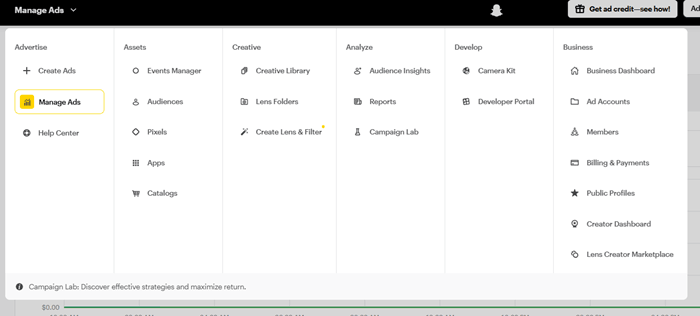
Snapchat Business Manager is the control center for company-level access. It is where a business can organize people, ad accounts, billing, pixels, catalogs, public profiles, and other assets. Think of it as the place where you decide who is allowed to do what.
This matters more than it seems. Many companies begin with one person creating an ad account under a personal login. The campaign may work, but ownership becomes messy when that person leaves.
A cleaner setup lets the business own the main assets and then assign the right level of access to employees, agencies, freelancers, or partners.
Give people only the access they need. A designer may need to upload creative but not change payment settings. A media buyer may need to manage campaigns but not own the Business Profile.
Review access regularly, especially after a role change. Use two-factor authentication for accounts with administrative permissions.
Business Manager is also where good record-keeping starts. Name your ad accounts, pixels, catalogs, and campaigns clearly.
“Spring sale test” may make sense in March, but it becomes confusing six months later. Use names that explain the market, campaign goal, audience, and date.
A simple system saves time when you compare results or hand the account to someone else.
How Snapchat Ads Manager Works

Snapchat Ads Manager is the self-service platform used to create, run, and measure Snapchat advertising campaigns. It lets you select a goal, build an audience, set a budget, upload creative, choose placements, and track performance.
The first step is choosing the right objective. Snapchat groups its current advertising objectives around outcomes such as awareness and engagement, traffic, leads, app promotion, and sales.
Snapchat simplified the previous set of objectives into five goal-based options. Pick the one that matches the action you actually want. Do not choose traffic if your real goal is purchases and you have the tracking needed to optimize for sales.
Next, choose an audience. You can target by location, age, gender, interests, devices, language, and other available signals. You can also use Custom Audiences based on customer lists or website activity, plus Lookalike Audiences to find people similar to existing customers.
Snapchat’s getting-started guide outlines these options and allows advertisers to set daily or lifetime spend limits.
Then build the ad.
Most Snapchat ads are full-screen and vertical. They need to make sense with sound off, but sound can add energy when it is useful. Use a clear first frame, show the product early, and keep text large enough to read quickly. Give the viewer one simple next step.
Ads Manager also provides reporting at campaign, ad set, and ad levels.
Check performance often, but do not overreact to the first few hours. Give the system enough time and budget to learn before making major changes.
Snapchat Ad Formats Worth Testing

The best Snapchat ad format depends on your offer.
A new local restaurant does not need the same format as a mobile game or a beauty brand. Begin with a simple vertical video ad, then add other formats once you understand what messages and audiences work.
Single image or video ads are a strong starting point. They are simple, full-screen placements with a call to action. Use them for launches, promotions, website traffic, app installs, lead forms, or direct sales. A 6–10 second video can be enough if the product is clear.
Collection ads work well for e-commerce because they combine a main image or video with tappable product tiles. They help people browse several items without needing to leave the experience immediately.
Story ads are useful when the message needs a sequence. A travel brand can show a destination, rooms, activities, food, and a booking offer in a short run of cards.
Commercials can be useful for reach and video viewing. AR ads and Lenses are better when people need to experience a product. Filters are lighter-weight visual overlays that can support events, locations, or timely campaigns.
Snapchat lists these formats, including Story ads, collection ads, commercials, AR experiences, and filters, in its ad-objective guide.
Do not launch every format at once. Test one or two formats against the same goal. This makes it easier to see what actually caused the result.
Building a Snapchat Marketing Strategy
A good Snapchat marketing strategy starts with a business problem, not a posting schedule.
Ask what you want to change in the next three to six months. You may need more local visits, cheaper app installs, stronger awareness among younger buyers, more email leads, or more sales from a product category.
Choose one primary goal. Then decide how organic content and paid ads will support it. For example, a skincare company may use public Stories and creator clips to build trust, save product tutorials to its profile, run conversion ads for bestsellers, and retarget site visitors who viewed a product but did not buy.
Plan content around a few repeatable themes.
A bakery could use “morning bake,” “today’s special,” “staff pick,” “customer question,” and “weekend offer.” A fitness studio could use “form tip,” “trainer advice,” “member win,” “class preview,” and “newcomer offer.”
Repetition is helpful when the audience understands what they will get from you. Keep the funnel simple.
Use broad content and awareness ads to introduce the brand. Use product demos, reviews, comparison clips, and creator content to help people consider it. Use a clear offer, catalog ad, lead form, or conversion campaign when people are ready to act.
Make sure the landing page matches the ad. A strong Snap ad can still fail if it sends people to a slow, confusing page.
Finally, build room for testing. Test hooks, offers, creators, audiences, landing pages, and ad formats. Change one main thing at a time.
The goal is not to find a “winning ad” forever. The goal is to learn what makes your customers respond.
The Best Businesses for Snapchat Marketing
Snapchat is not limited to fashion, beauty, or entertainment, although those categories fit naturally. Any business with a visual product, a useful demo, a location, or a strong personality can find an angle.

E-commerce brands can use Snapchat to show real products in use.
Clothing brands can create outfit clips, try-on Lenses, new-drop previews, and customer videos. Food and drink brands can show preparation, limited offers, recipes, store visits, and creator tastings. Beauty brands can use tutorials, shade matching, AR try-ons, and before-and-after content.
Local businesses have a practical advantage. Restaurants can promote lunch offers and events. Gyms can show classes and member stories. Car dealerships can show new arrivals and test-drive offers. Colleges can give campus tours. Tourist attractions can reach nearby visitors. A location-specific campaign can be more useful than trying to reach an entire country.
Apps and online services also fit the platform well. A budgeting app can show a problem and a solution in seconds. A delivery app can promote a first-order offer. A game can use lively gameplay footage. A ticketing company can promote a concert or sports event near the date and location.
The weakest fit is a business with no visual story, no clear customer action, and no desire to experiment. Even then, a human story can create content.
A law firm can answer common questions. A manufacturer can show how something is made. A B2B company can create short problem-solving videos for people who influence purchasing decisions.
Snapchat Content Ideas for Businesses
Good Snapchat content feels immediate. It does not need to be perfect. It needs to be easy to understand and worth watching.
A phone camera, decent light, a clear voice, and a useful idea are enough for most organic posts.
Start with behind-the-scenes content. Show how an order is packed, how a meal is made, how a design is chosen, or how a team prepares for an event. These clips work because they show real people and real work. They make a business easier to trust.
Use quick demonstrations. Show how to use a product, how long something takes, what comes in the box, or what a customer can expect during an appointment. Answer one question per video. “Will this fit in a small kitchen?” is better than a vague product showcase.
Other useful Snapchat content ideas include limited-time offers, new arrivals, staff picks, polls, customer reactions, before-and-after clips, mini tutorials, local guides, event countdowns, and creator takeovers. Spotlight can help a brand reach people beyond its existing audience by making short, entertaining public videos.
Create a simple weekly rhythm. Post useful content regularly, but do not force a post just to fill a calendar. Watch completion rates, replies, shares, screenshots, profile visits, and link activity. If a format gets real questions from viewers, make it a recurring series.
Using Snapchat AR, Creators, and Snap Map
AR can make a product more memorable by giving people something to do. A Lens should not exist only because it looks impressive in a presentation. It should help someone try, play, visualize, personalize, or share.
A cosmetics brand can create a shade try-on. An eyewear brand can let people test frames. A furniture company can help customers imagine an item in a room. A movie studio can create a character Lens that people want to send to friends. The best Lenses are easy to understand in a second or two.
Creators can add credibility and speed. Choose creators whose audience and style fit the product. Look beyond follower numbers. Watch whether people comment, whether the creator can explain a product naturally, and whether their audience is in the right market.
Give creators a clear brief, but do not make every line sound like it came from a legal department.
Snap Map is especially useful for place-based businesses and events. People use it to see what is happening nearby and where friends or places are.
A local campaign can support store openings, restaurant launches, concerts, sports events, seasonal attractions, and special offers.
Snap reported that Snap Map passed 450 million monthly active users, making it more than a side feature for location-driven marketing.
Snapchat Analytics: What to Measure
Do not judge Snapchat marketing by views alone. A view can be useful for awareness, but it does not prove that the campaign helped the business. Start with the metric closest to your goal.
For awareness, watch reach, impressions, frequency, video view rate, and completed views. For traffic, watch swipe-ups, landing page views, click-through rate, and the quality of the sessions that arrive on your website. For leads, track completed forms, cost per lead, lead quality, and the percentage of leads that become customers.
For e-commerce, focus on add-to-cart actions, purchases, cost per purchase, revenue, and return on ad spend.
Install campaigns should track cost per install, registration rate, trial starts, subscriptions, and long-term retention. An inexpensive install is not useful if those users never open the app again.
Set up the Snap Pixel or the relevant app measurement tools before spending heavily. Without reliable event tracking, Ads Manager has less information to optimize toward, and your team has less confidence in the results.
Use consistent UTM parameters so Snapchat traffic can be reviewed alongside other channels in analytics software.
Review results by audience, creative, placement, device, and campaign goal. Look for patterns rather than one lucky day.
If one video has a low cost per purchase, ask why. Did it show the product sooner? Was the offer clearer? Did the creator make the message feel more believable? Those lessons are more valuable than simply copying the video.
Common Snapchat Marketing Mistakes
The first mistake is treating Snapchat like a smaller version of another platform. A square graphic filled with tiny text may work elsewhere, but it usually feels out of place in a full-screen mobile app. Make creative specifically for vertical viewing and show the point early.
The second mistake is making everything look like an ad. Snapchat users are quick to skip content that feels stiff, slow, or overly polished. This does not mean you should make poor-quality work. It means the creative should feel direct and human. Use real products, real settings, and language that a customer would actually use.
Another common mistake is choosing the wrong objective. If you want online sales, optimize for sales when your tracking is ready.
Do not optimize for cheap clicks and then wonder why clicks do not become customers. Give each campaign one job.
Businesses also make changes too quickly. Turning campaigns on and off every day prevents useful learning.
Snapchat recommends allowing time for its delivery system to explore, and its guidance suggests a daily budget of at least $30 and a run of at least 15 days for the exploration phase. Treat that as a starting point, not a guarantee.
Your budget should match your market, audience size, and conversion volume.
Finally, do not ignore comments, messages, profile quality, landing pages, and customer service. Marketing can create interest. The rest of the business must be ready to handle it.
Snapchat vs. Instagram, TikTok, and YouTube Shorts
Snapchat, Instagram, TikTok, and YouTube Shorts all use short-form video, but they serve different habits. It is better to use each platform for its strengths than to expect identical results everywhere.
| Platform | Strong use case | Typical content style | Useful business advantage |
|---|---|---|---|
| Snapchat | Close communication, AR, local discovery, direct response | Casual, fast, vertical, personal | Strong camera and messaging culture |
| Brand building, community, shopping, visuals | Polished but flexible | Mature profile and social-commerce ecosystem | |
| TikTok | Broad discovery and entertainment | Trend-led, creator-led, fast | High potential for reach beyond followers |
| YouTube Shorts | Searchable video discovery and education | Useful, evergreen, visual | Connects short clips with longer videos and search |
Instagram is better for a polished visual portfolio and ongoing community management. TikTok can be excellent for cultural reach and fast discovery. YouTube Shorts can help a brand turn useful video ideas into long-term search visibility.
Snapchat stands out when a business wants to feel close, visual, and immediate. Its AR tools, private-message culture, Snap Map, and ad products give it a different role.
You do not have to choose only one platform. A smart content team can adapt the same core idea for each platform rather than posting the same file everywhere.
Real Snapchat Marketing Examples to Learn From

Taco Bell has long been one of the best-known brands that understands Snapchat’s playful side. Its earlier branded Lenses and fast, food-focused content worked because they were easy to understand and fun to share. The lesson is that a brand should use the camera in a way that fits its personality.
Beauty brands such as NYX Cosmetics have shown why AR is useful for products people want to try before buying. Makeup is a natural fit because users can see a shade or effect on their own faces.
The business value comes from reducing uncertainty and making the product experience more engaging before the sale.
Adidas and Puma provide another useful lesson. Sportswear marketing works when it connects a product with movement, identity, athletes, and community. A shoe is rarely just a shoe in short-form content. It is part of a workout, a match, a style choice, or a personal goal.
The company said Carl’s Jr. used Promoted Places and saw an 18% lift in incremental visits, alongside gains in ad awareness and brand favorability. Location-focused campaigns can be measured against real store traffic, not just online engagement.
The common thread is simple. These brands use Snapchat features to make the experience more visual, participatory, or local. They do not treat the app as a passive billboard.
Final Thoughts
Snapchat marketing works when a business stops trying to look like a traditional advertiser and starts acting like a useful, interesting part of someone’s day. The platform rewards clear visual ideas, fast communication, honest creativity, and a real understanding of the customer.
Start with the basics. Build a complete Snapchat Business Profile. Create a few useful public Stories. Set up tracking. Choose one marketing goal. Make several simple vertical videos. Then run a measured campaign through Snapchat Ads Manager and learn from the results.
You do not need to use every Snapchat feature at once. A local business may begin with Stories and location-based ads. An e-commerce company may begin with product videos and conversion campaigns. A beauty brand may later add AR. The best Snapchat strategy is the one that aligns with your customers, your offer, and your ability to create content people actually want to watch.