Finding the right keyword can make a big difference to your SEO results. A popular keyword may look attractive, but ranking for it can be difficult as established websites dominate Google search results.
Low competition keywords give bloggers, small businesses, and content writers a more realistic starting point. The best opportunities combine reasonable search demand, manageable competition, and clear search intent.
This guide shows you how to find low-competition keywords, assess whether they are truly worth targeting, and turn them into content that attracts qualified visitors.
Direct Answer
To find low competition keywords, start with broad topics and use keyword research tools to find related terms with low difficulty and useful search volume. Then check Google’s search results to assess competition, search intent, backlinks, and content quality. For high-traffic opportunities, look for keywords where weaker websites rank and pages receive traffic from related searches.
- What Are Low Competition Keywords?
- Why Should You Target Low Competition Keywords?
- How to Find Low Competition Keywords
- 1. Start With Seed Keywords
- 2. Expand Your Seed Keywords
- 3. Filter by Keyword Difficulty
- 4. Look for Long-Tail Keywords
- 5. Use Google Autocomplete
- 6. Use People Also Ask
- 7. Check Related Searches
- 8. Research Your Competitors
- 9. Find Keyword Gaps
- 10. Look for Weak Websites in the SERPs
- 11. Check Search Intent
- 12. Check Search Volume
- How to Find High Search Volume, Low Competition Keywords
- How to Find Low Competition Keywords With High Traffic
- Low Competition Keywords List: Ideas for Bloggers
- Low Competition Keywords for Small Businesses
- Low Competition Keywords for Content Writers
- Free Ways to Find Low Competition Keywords
- Best Tools to Find Low Competition Keywords
- How to Choose the Best Low Competition Keywords
- Use a Keyword Scoring System
- Do Not Ignore Traffic Potential
- How to Use Low Competition Keywords in Your Content Strategy
- What to Do After Finding Low Competition Keywords
- How to Build a Low Competition Keyword List
- How Frequently Should You Do Keyword Research?
- Final Thoughts
- FAQ
What Are Low Competition Keywords?

Low-competition keywords are search terms with relatively few strong pages competing for top positions in search results.
For example, “SEO” is extremely broad and competitive. A newer blog would have a hard time ranking for it.
A phrase such as “SEO tips for new bloggers” is more specific. The audience is smaller, but the search intent is clearer. The pages ranking for the query may have fewer backlinks, less detailed content, or weaker topical relevance.
That can create a better opportunity.
Low competition does not mean that nobody is targeting the keyword. It means the current search results may leave room for another useful page.
You can judge competition using several signals:
- Keyword difficulty
- Search volume
- Traffic potential
- Number and quality of backlinks
- Authority of ranking websites
- Relevance of ranking pages
- Content quality
- Search intent
- Freshness of existing content
A keyword tool can give you useful numbers, but the Google results provide the final reality check.
Why Should You Target Low Competition Keywords?

New websites rarely have the same authority as large publications. A small business website may have only a few links. A new blog may have no ranking history at all.
Trying to compete immediately for broad terms can consume a lot of time.
Low competition keywords let you focus on smaller search opportunities where your content has a better chance of appearing.
They can help you:
- Build organic traffic
- Attract a more specific audience
- Create useful content around real questions
- Build topical authority
- Discover new content ideas
- Generate leads from targeted searches
- Build a foundation for more competitive topics
There is another benefit. A specific query can reveal exactly what a person wants.
Someone searching for “content marketing” has a broad need. On the other hand, someone searching for “content marketing ideas for a small business” has a much clearer problem.
The second search gives you a stronger direction for your article. That makes low competition keyword research useful for both SEO and content planning.
If you want to explore more tools for discovering keyword opportunities, check out our guide to the best keyword research tools.
How to Find Low Competition Keywords

The process does not start with a keyword difficulty filter. Start with your audience.
Think about the problems people have, the questions they ask, the products they compare, and the tasks they need help with. Then turn those ideas into keyword research.
Here is a practical process you can use.
1. Start With Seed Keywords
A seed keyword is a broad term that gives you a starting point for research.
For a blogging website, your seed keywords could include:
- Blogging
- Blog traffic
- SEO
- Content writing
- Keyword research
- WordPress
- Content marketing
For a small business website, you could start with:
- Local SEO
- Email marketing
- Social media marketing
- Online advertising
- Business website
- Customer reviews
For a content writer, useful seed terms could include:
- Blog writing
- SEO writing
- Content strategy
- Freelance writing
- Content research
Do not try to select your final keyword at this stage. Write down 10 to 20 broad subjects. These become starting points for finding more specific phrases.
2. Expand Your Seed Keywords
Enter each seed keyword into a keyword research tool.
You can use platforms such as Ahrefs, Semrush, Ubersuggest, or Keyword Planner.
Look for:
- Related keywords
- Question keywords
- Long-tail phrases
- Comparisons
- “How to” searches
- “Best” searches
- “For beginners” phrases
- Industry-specific queries
For example, start with:
blog traffic
You could discover:
- How to get traffic to a new blog
- How to increase blog traffic
- How to get free traffic to a blog
- How to get traffic to a blog without social media
- How to promote a new blog
- How to increase organic traffic to a blog
Some of these terms may have modest search volume. That does not automatically make them poor targets.
A keyword with 100 searches a month can be useful if the searchers are highly relevant to your business.
3. Filter by Keyword Difficulty
Keyword research platforms provide difficulty scores to estimate how hard it could be to rank.
There is no universal score that makes a keyword easy.
Semrush, Moz, Ahrefs, and other platforms use their own calculations. Ahrefs, for example, bases its KD score heavily on the number of referring domains pointing to top-ranking pages. Semrush uses its own model and provides additional metrics for evaluating keyword difficulty.
As a starting point, you could create these working groups:
| Keyword difficulty | Initial approach |
|---|---|
| 0–10 | Strong opportunity for newer websites |
| 11–20 | Worth investigating |
| 21–30 | Check the SERP carefully |
| 31–50 | Consider site authority and competition |
| 50+ | Usually requires stronger authority |
These ranges are not rules.
A keyword with a KD of 15 can still have a tough SERP. A keyword with a KD of 30 can sometimes have weak pages ranking near the top.
Use the score to narrow your research. Then inspect Google.
Semrush currently recommends low-difficulty filtering as a way to identify easier opportunities, while its newer Personal Keyword Difficulty metric can assess difficulty relative to a specific website.
4. Look for Long-Tail Keywords
Long-tail keywords contain more specific phrases.
Compare:
blogging
with:
How to start a blog for a small business
The second phrase has a narrower audience. That can reduce search volume, but it can give you a better content angle.
Try adding useful modifiers to your seed terms:
- for beginners
- for small business
- for bloggers
- for freelancers
- without a website
- without spending money
- free
- step by step
- examples
- checklist
- template
- tools
- alternatives
- comparison
For example:
Keyword: email marketing
Possible long-tail variations:
- email marketing for small business
- email marketing ideas for bloggers
- free email marketing tools for small businesses
- How to build an email list for a blog
- email marketing ideas for beginners
Do not assume a long-tail keyword is automatically easy to rank for. Search for it before creating the content.
5. Use Google Autocomplete
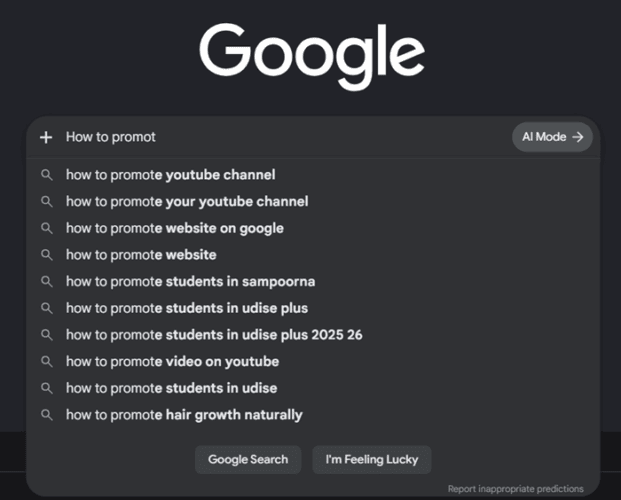
Google itself is a useful source of keyword ideas. Start typing your topic into the search box.
For example:
How to promote a blog
Google may suggest phrases related to:
- How to promote a blog for free
- How to promote a blog on social media
- How to promote a new blog
- How to promote a blog after publishing
These suggestions reflect searches connected to the phrase you entered.
Collect useful ideas and test them in a keyword tool.
You can do the same with words such as:
- best
- free
- how
- why
- for
- without
- vs
- tools
- examples
Autocomplete is useful for discovering conversational searches that may not come to mind during manual brainstorming.
6. Use People Also Ask
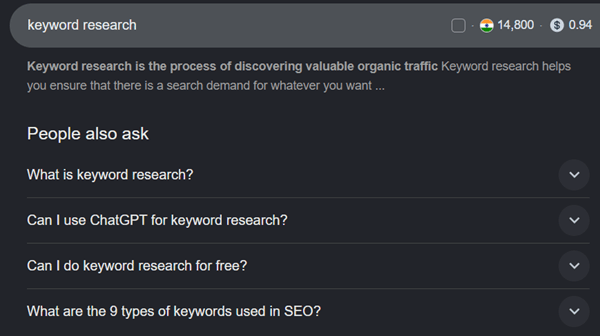
Search for your main topic on Google and look for the “People Also Ask” section.
For a topic such as keyword research, you might find questions about:
- What is keyword research?
- How do beginners find keywords?
- What is a good keyword difficulty?
- How do I find low competition keywords?
- Which keyword research tool is best?
These questions can help you discover supporting topics. You do not need to create a separate article for every question.
If several questions have the same intent, answer them on a single comprehensive page.
If a question has a completely separate intent, consider creating another article.
This approach can help you build topic clusters without publishing thin pages.
7. Check Related Searches
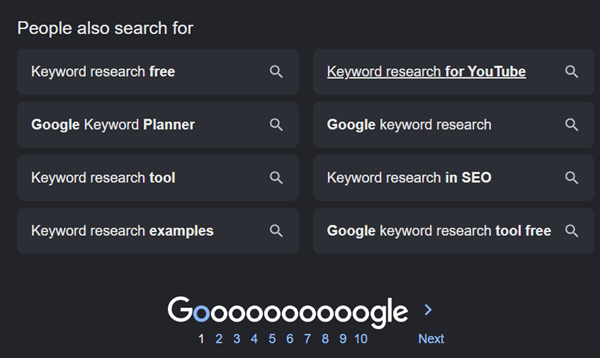
Scroll to the bottom of Google’s results page. You will usually find related searches connected to your query.
These suggestions can reveal:
- Longer phrases
- Alternative wording
- Related problems
- Comparison searches
- Question-based searches
Take useful phrases from this area and run them through your keyword tool.
Do not add every related phrase to your article. Keep only terms that help answer the reader’s main question.
8. Research Your Competitors

Competitor research is one of the fastest ways to discover proven keyword opportunities.
Find three to five websites that target the same audience. Then, enter their domains into an SEO platform.
Look for keywords where:
- They rank in the top 10
- Keyword difficulty is manageable
- Search demand exists
- Their page receives organic traffic
- Your website does not rank
- Their content could be improved
Semrush recommends using competitor rankings and its Keyword Gap tool to locate terms competitors rank for while your site does not.
Ahrefs provides a similar workflow. Its Organic Competitors report can reveal keywords that competing websites rank for, and users can filter the results by KD.
This is useful because the keyword already has evidence of search demand.
You are not starting from a blank page.
9. Find Keyword Gaps
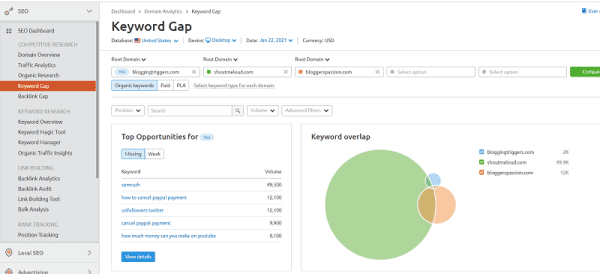
A keyword gap is a topic your competitors cover, but your website does not.
Suppose you run a small digital marketing blog.
Your competitor ranks for:
social media content ideas for small business
Your site has several articles on social media marketing, but none directly address this query.
That could be a content gap.
Now check:
- Search volume
- Keyword difficulty
- Search intent
- Ranking pages
- Traffic potential
- Business value
If the opportunity looks promising, create content that answers the query more effectively.
Do not copy the competitor’s article. Study what it covers, identify missing information, and create your own structure.
10. Look for Weak Websites in the SERPs
This is one of the most useful checks for finding low-competition keywords.
Search the keyword on Google.
Look at the first page.
Ask:
Who is ranking?
If the entire first page is filled with huge websites with thousands of backlinks, the keyword may be difficult.
If you see small blogs, niche websites, forums, or pages with limited backlinks, the opportunity may be stronger.
Look for signs such as:
- Thin content
- Old information
- Poor formatting
- Weak explanations
- Pages that only partially answer the query
- Low-authority websites
- Few referring domains
- Poor search intent alignment
Ahrefs recommends looking for keywords where lower-authority domains appear near the top of the SERP. A high Domain Rating can indicate an opportunity, though it does not guarantee a ranking.
Backlinko gives similar advice: there is no universal Domain Authority or Page Authority threshold. You need to learn what a normal SERP looks like in your niche and compare the strength of the pages competing for the term.
11. Check Search Intent
Search intent tells you what the person expects to find.
There are four broad categories.
Informational intent
The user wants information.
Examples:
- How to find keywords
- What is keyword difficulty
- How does SEO work
Commercial investigation
The user is comparing options before making a decision.
Examples:
- Semrush vs Ahrefs
- best keyword research tools
- best SEO tools for bloggers
Transactional intent
The user is ready to take an action or buy something.
Examples:
- Buy SEO software
- Semrush pricing
- keyword research tool subscription
Navigational intent
The user wants to reach a particular website or page.
Examples:
- Google Keyword Planner
- Ahrefs login
- Semrush dashboard
Your content needs to match the intent.
If Google ranks tutorials for a query, creating a product page may not work well.
If Google ranks comparison articles, a basic educational post may struggle.
Semrush highlights search intent as one of the key checks beyond keyword difficulty.
12. Check Search Volume

Search volume tells you how frequently a keyword is searched within a selected market and time period. It is useful, but do not treat it as the only deciding factor.
Suppose you find two keywords:
Keyword A: 10,000 searches per month
Keyword B: 300 searches per month
Keyword A looks more attractive.
Then you inspect the SERP and discover that major websites dominate the first page.
Keyword B has 300 searches, and three small websites rank near the top.
Keyword B may be the better target for a newer website.
The right question is not:
“Which keyword has the highest volume?”
Ask:
“Which keyword gives my website a realistic chance to attract useful visitors?”
How to Find High Search Volume, Low Competition Keywords
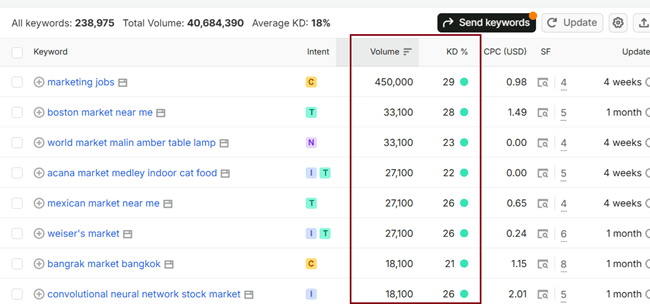
High search volume, low competition keywords are attractive because they combine demand with a lower barrier to entry.
They are not impossible to find, but you should expect fewer opportunities than you would find by targeting low-volume phrases.
Start with a broad seed topic.
Then use a keyword tool to:
- Set a minimum search volume.
- Set a low or moderate KD limit.
- Review the results.
- Remove irrelevant terms.
- Check search intent.
- Inspect the first page of Google.
- Review the authority and backlinks of ranking pages.
- Check traffic potential.
- Select terms that fit your website.
Ahrefs demonstrates this approach by combining a minimum search volume with a low KD filter to find high-volume, low-competition terms. It recommends adjusting the numbers based on the niche’s size and breadth.
Do not set an aggressive volume requirement at the start.
For a small niche, 100 searches may be useful.
For a broad industry, you may prefer 500 or 1,000 searches.
Your website’s current authority should guide the final choice.
How to Find Low Competition Keywords With High Traffic
Search volume and traffic potential are not the same thing.
A keyword may have 1,000 searches per month, but a page ranking first may receive clicks from dozens of related searches too.
That page could generate far more traffic than the main keyword’s volume suggests. This is why traffic potential is useful.
Look for pages that:
- Rank for several related keywords
- Receive organic traffic
- Have relatively few backlinks
- Target a topic relevant to your audience
Examine competitor pages that receive substantial search traffic from low-difficulty keywords. This can reveal topics where a page gets traffic without requiring a large backlink profile.
For example, imagine you find a competitor’s article that gets 800 estimated monthly organic visits.
The page ranks for 150 keywords. Its main keyword has a KD of 12.
That is worth investigating.
The opportunity may not be the exact keyword that brings the most traffic. The broader topic could allow your page to rank for a group of related searches.
This is one of the best ways to find low competition keywords with high traffic potential.
Low Competition Keywords List: Ideas for Bloggers

Here are keyword themes you can investigate for a blogging website.
Blogging
- low competition keywords for blogs
- keyword research for new blogs
- How to choose keywords for a blog
- How to find keywords for a new website
- How to find blog keywords
- long-tail keywords for blogs
- low competition blog topics
- easy keywords to rank for
- SEO keywords for new blogs
Blog traffic
- How to get traffic to a new blog
- How to increase organic blog traffic
- How to promote a new blog
- How to get free traffic to a blog
- How to find blog topics people search for
Content planning
- How to find blog topics
- content ideas from keywords
- How to create a content cluster
- How to find content gaps
- How to find the questions people search for
Treat this as an idea bank, not a list of guaranteed ranking keywords. Check the volume and competition for your target country before selecting a term.
Low Competition Keywords for Small Businesses
Small businesses can benefit from highly specific keywords that describe a product, service, location, or customer problem.
Try researching phrases such as:
- Low competition SEO keywords for a small business
- keyword research for small business
- SEO keywords for small businesses
- local keywords for small business
- low competition local keywords
- How to find local keywords
- local SEO keyword ideas
- Keywords for local services
- SEO keywords for service businesses
- How to find customer search terms
You can make these more specific by adding a service and a location.
For example:
web designer + city
could become:
affordable web designer in [city]
A phrase like this can have lower volume than “web design,” but the searcher has a much clearer need.
For a local company, 20 highly relevant visitors can be more useful than hundreds of visitors looking for general information.
Low Competition Keywords for Content Writers
Content writers can use keyword research to find both clients and content opportunities.
Potential terms include:
- SEO keywords for content writers
- keyword research for content writers
- How to find keywords for content writing
- SEO writing keywords
- How to research keywords for an article
- how to choose keywords for a blog post
- content writing keyword research
- long-tail keywords for content writing
- How to find content ideas from keywords
A content writer can go one step further.
Look for phrases related to specific client industries.
For example, a writer who specialises in SaaS could research:
- SaaS content writing
- SaaS blog topics
- SaaS SEO content
- SaaS content ideas for startups
The more clearly your keyword matches your service, the easier it becomes to turn organic traffic into leads.
If you need more ideas for turning keyword research into useful content, read our guide on how to generate unlimited blog post ideas.
Free Ways to Find Low Competition Keywords
You do not need an expensive SEO platform to start keyword research.
Google provides several free sources.
Google Autocomplete
Use search suggestions to discover real query variations.
People Also Ask
Find questions connected to your topic and use them for content planning.
People also search for (Related Searches)
Look at Google’s suggestions at the bottom of the SERP.
Google Trends
Compare interest over time and identify topics that are growing or declining.
Google Keyword Planner
Use it to discover keyword ideas and estimate search demand.
Google Search Console
If your site already receives search impressions, Search Console can reveal queries where you appear but do not yet rank strongly.
Search niche communities for questions, complaints, and recurring problems.
Reddit can reveal phrases that people use naturally. Those phrases can become seed ideas for further keyword research.
Best Tools to Find Low Competition Keywords
You have plenty of options. Pick a tool based on your budget and how deeply you need to research.
Semrush

Semrush provides keyword difficulty, search volume, intent, competitor research, Keyword Gap, and related keyword data. Its current workflow includes Personal Keyword Difficulty, which can make competition estimates more relevant to a specific domain.
Ahrefs

Ahrefs is useful for keyword discovery, SERP analysis, competitor research, backlinks, traffic potential, and identifying low-authority pages that rank for valuable terms.
Ubersuggest

Ubersuggest is a beginner-friendly option for keyword suggestions, search volume, SEO difficulty, CPC, and competitor research.
Google Keyword Planner

Google’s tool can provide keyword ideas and search volume ranges. It is especially useful when you want free keyword data from Google’s advertising platform.
AnswerThePublic

AnswerThePublic can help you discover question-based searches and long-tail content ideas. It is useful during the idea-generation stage.
How to Choose the Best Low Competition Keywords
Once you have a large list, do not publish an article for every keyword.
Analyze each term.
You can use a simple five-factor system:
1. Relevance
Does the keyword match your audience?
If not, remove it.
2. Competition
Is the SERP realistic for your website?
Check the ranking pages. Analyze their backlinks and referring domains. If you have a better backlink profile, go ahead.
3. Search demand
Does the keyword have enough demand to justify creating content? Check the monthly search volume, CPC, and personalized difficulty score.
4. Intent
Can you create the type of page Google expects? Visit Google and search with your target keywords. The top results give you an idea about search intent. Is it informational, transactional, or other intent? Analyze and make a decision.
5. Business value
Can the visitor help you reach a business goal?
A keyword can score well on SEO metrics and still have little value for your website.
For example, a freelance writer may find a low-competition keyword about a random technology topic. It may bring traffic, but if the writer wants clients for SEO content, the traffic may not help the business. You will get visitors, but they will leave without converting.
Use a Keyword Scoring System
A simple spreadsheet can make the process easier.
Create columns for:
| Keyword | Volume | KD | Intent | Traffic potential | SERP strength | Business value | Priority |
|---|---|---|---|---|---|---|---|
| Keyword A | 500 | 12 | Informational | High | Weak | High | High |
| Keyword B | 2,000 | 48 | Informational | High | Strong | Medium | Medium |
| Keyword C | 150 | 8 | Commercial | Medium | Weak | High | High |
This prevents you from selecting a keyword based on a single factor like KD or search volume.
You can give each factor a score from 1 to 5 and calculate a total.
For example:
Relevance × 5
Business value × 4
SERP opportunity × 4
Traffic potential × 3
Keyword difficulty × 2
This gives commercially useful keywords more weight than raw search volume.
Do Not Ignore Traffic Potential
A keyword with 100 searches can still produce substantial traffic if the page ranks for related terms.
Suppose your article targets:
How to promote a blog
Your page may rank for:
- How to promote a blog
- How to promote a new blog
- blog promotion strategies
- ways to promote a blog
- free blog promotion
- How to get readers to a new blog
The combined traffic can be much larger than the volume of the primary phrase.
This is why a good article should cover a topic fully. Do not repeat the exact keyword in every paragraph. Cover all matching keywords to rank for them and get traffic.
Ensure that you are not targeting very similar keywords with separate articles. It will create unnecessary competition between your own URLs.
Consider covering closely related terms in one stronger article when the search intent is the same.
How to Use Low Competition Keywords in Your Content Strategy
Keyword research works best when it supports a larger content plan.
Suppose your pillar topic is:
Blog SEO
You could build supporting articles around:
- How to find low competition keywords
- How to optimize blog posts for SEO
- How to write SEO-friendly titles
- How to improve internal linking
- How to find long-tail keywords
- How to update old blog posts
- How to create topic clusters
Link these pages together naturally. The pillar page introduces the broad subject.
Supporting pages should answer specific questions.
This structure helps readers move from one topic to another while giving search engines a clear view of your site’s subject coverage.
You might also be interested in these posts:
What to Do After Finding Low Competition Keywords
Keyword research is only the beginning. It should be followed by SERP analysis, finding missing information in the top-ranking pages, and creating comprehensive content with all possible matching keywords.
Once you have selected your target term:
1. Confirm the SERP
Search the keyword manually.
2. Study the top results
Look at their structure, depth, freshness, and backlinks.
3. Identify missing information
Find questions that the existing pages fail to answer.
4. Select the primary keyword
Choose one main search term for the page.
5. Add supporting terms
Use related queries naturally in relevant sections.
6. Build the outline
Organize the article around search intent.
7. Write the content
Give the reader a complete answer.
8. Add internal links
Connect the new page to relevant existing articles.
9. Optimize the page
Review the title, URL, headings, introduction, images, links, and metadata.
10. Track performance
Watch impressions, clicks, rankings, and conversions in Search Console and your SEO platform.
11. Update the article
Search results will change daily. New competitors appear with fresh content. You will also see changes in the search behavior.
Review your important pages periodically and improve them when the data shows a clear opportunity.
How to Build a Low Competition Keyword List
A useful keyword list should not contain hundreds of random phrases. You should organize it into groups.
For example:
Topic: Blog Traffic
Primary keyword:
How to increase blog traffic
Supporting keywords:
- How to get traffic to a new blog
- free blog traffic strategies
- How to promote a blog
- blog traffic sources
- How to increase organic blog traffic
Topic: Keyword Research
Primary keyword:
How to find low competition keywords
Supporting keywords:
- high search volume, low competition keywords
- high volume low competition keywords
- how to find low competition keywords with high traffic
- low competition keywords list
- low competition keyword research
- low competition long-tail keywords
Grouping terms like this makes content planning easier. It can prevent you from writing several pages that answer the same question.
How Frequently Should You Do Keyword Research?
You do not need to start from scratch every week.
Review your keyword opportunities when:
- You start a new content category
- You launch a new product
- Your audience changes
- Your competitors publish new content
- Search demand changes
- Your traffic drops
- You want to build a new topic cluster
Google Search Console is very useful after you have published content. It can reveal queries that generate impressions even when they were not part of your original keyword plan.
Those queries can lead to new sections, new articles, or content updates.
Final Thoughts
The goal of keyword research is not to find the keyword with the biggest number beside it.
Your goal is to find a search term that your website can realistically compete for and that brings the right audience.
Start with seed topics. Expand them into specific searches. Filter for manageable difficulty. Check search volume and traffic potential. Study competitors. Then search Google yourself.
Pay close attention to the pages already ranking. If small websites appear on page one, the content is weak, or the ranking pages do not fully satisfy the query, you may have a useful opportunity.
High search volume low competition keywords can be excellent targets, but do not wait for a perfect keyword with huge volume and almost no competition. Those opportunities are limited.
A better strategy is to build a list of relevant, realistic keywords and prioritize the terms that combine search demand, weak SERP competition, clear intent, traffic potential, and business value.
That is how you turn keyword research into a practical SEO strategy.